
Imagine you are exploring the ocean looking for new islands. You are scanning the horizon with a telescope in hand. Short of getting visual confirmation of an island, you’re left wandering and guessing. Sailors, however, eventually found an early detection system: birds. If they saw seagulls swirling on the horizon, they knew land could not be far away.
(In fact, there are stories as wide ranging as Noah and Gilgamesh keeping birds on their boats and sending them away as scouts. If they came back, they knew there was no land around. If they did not, they were close.)
While our peers in demand marketing and performance marketing often have GPS-like “attributable” metrics, brand and content marketing has always been the art of looking for seagulls.1 When you’re running an editorial program, most feedback is “directional” — you’re often not sure you’re right, until you’re very right.
When vibe coding became possible, I thought this would be a boon for measuring the success of the editorial and thought leadership programs we create for our clients at Anthology. Suddenly we could plug into all of the internal data sources and put together a dashboard to end them all, right?
But rather than making the “directional” more “attributable”, the reverse happened: We’ve never been more capable of tracking our metrics, and yet formerly measurable channels like SEO are being replaced by less measurable ones, like AI chat.2
It’s as if every island is invisible, no one has a telescope, and there are seagulls everywhere.
This Anthology Brief is about how to look for seagulls as you build your program, and is the template of what we suggest to clients.
You’re in the long game now
An editorial program is a long-term investment. It. Is. A. Long. Term. Investment.
When it works, it will provide an immense benefit to your business, those benefits compound, and create a moat that your competition has to reckon with each and every quarter as you pull further and further ahead.
But the investment needed takes time to bear fruit, and you may feel compelled to over engineer a bunch of quantitative metrics to track to make yourself feel better until the big numbers come in.
Do not do this.
Your early signals are:
- *Small. The numbers will not impress you at first. The right people are better than the most people. Your early work is making sure your work is reaching the kind of people you want first, then you can scale.
- *Anecdotal. You will hear people mention things. Someone on a call will say they’ve heard about something via your content. A term you made up will be used elsewhere. Your CEO will be at a dinner where someone says they read a post. This is the currency of an early editorial program.
- *Cumulative. Strong editorial lives for years3 and builds a program and a body of work. This is a different operating cadence as, say, social media which is a feed that needs to be filled constantly. You must measure things across their lifetime and not just the day they are published.
Here’s what that looks like in practice: each seagull is a “gate” that unlocks the next one. In other words, they usually happen in roughly this order:
Early days
Staff vibes
When you build an editorial program your earliest readers are your teammates. This is especially true if your content is reaching new audiences or taking a new approach. Reaching new people takes time. Any existing audience may take a while to adjust and thus give thoughtful feedback. But your colleagues? They will let you know right away what they think.
The real bellwethers for your early success are your customer-facing teams who are almost always ahead of the leaders you are reporting results to. People lie to marketers all the time. No one lies to a salesperson, they either buy or they don’t. No one lies to a customer success rep, if the product is bad, the customer cancels.
Your earliest sign of success is if these team members start praising your work. Not because they personally “like” it,4 but because it mirrors the kind of things they’ve seen your customers care about.
You’ll hear things like “our customers talk about this all the time!” or “I can’t wait to show this to [insert account here].” Or my yellow sun: “Finally!”
Sales call mentions
One of the first things you should do is set up alerts in whatever sales call transcription service your company uses for words like:
- *“Content”
- *“Blog post”
- *“Podcast”
- *“Article”
- *“Report”
As well as any “owned terms” you are using such as your product category name (Customer Harness Company, anyone?) or thought leadership concepts (more there later). Seeing those terms bubble up is a more accurate indicator than any other lead attribution that your content and editorial work is driving leads.
You should not only track that these terms are being used, but you should also track who is using them. At first, these mentions won’t come from the prospects, they’ll come from your team (because they’re so happy with your work, remember?).
But a sign of maturity is when prospects work their way through the funnel and come to the sales call having read and internalized thought leadership so much so that they mention it and it positively impacts the sale.
We’re seeing signs of life…
AI citations and SERP rankings
Around month three of publishing content is about when you should start to see some movement in the two kinds of “searches.” However, the way you respond to each one is different.
Search engine results pages (or SERPs) — Have eyes on the terms related to your product and product features, yes. But also your owned terms and concepts, executives, blog authors, research statistics, and other outputs of your editorial program. Seeing you rank off the first page on something you care about is a good sign to check what the links ahead of you have in common and whether you should change your tack. A warning: your early goal is not to “rank” it’s to “influence.” There’s a bit of a dance here where you cannot overoptimize for search, but you should keep your eyes on it.
AI citations — We’ve written about the black box of AEO and AI chats previously. AI citations are directional and extremely noisy in the short term.
However, thought leadership may (and often does!) result in increasing the likelihood you get cited. Make changes, wait, and see if you see a related spike in AI citations and mentions, yes. But your main measurement is an overall rise in people searching for your company in the AI chats. Your brand work has the highest impact in getting people to AI search for you in the first place.
It’s step zero in the AI search journey and impossible to measure directly.
Externally used owned terms
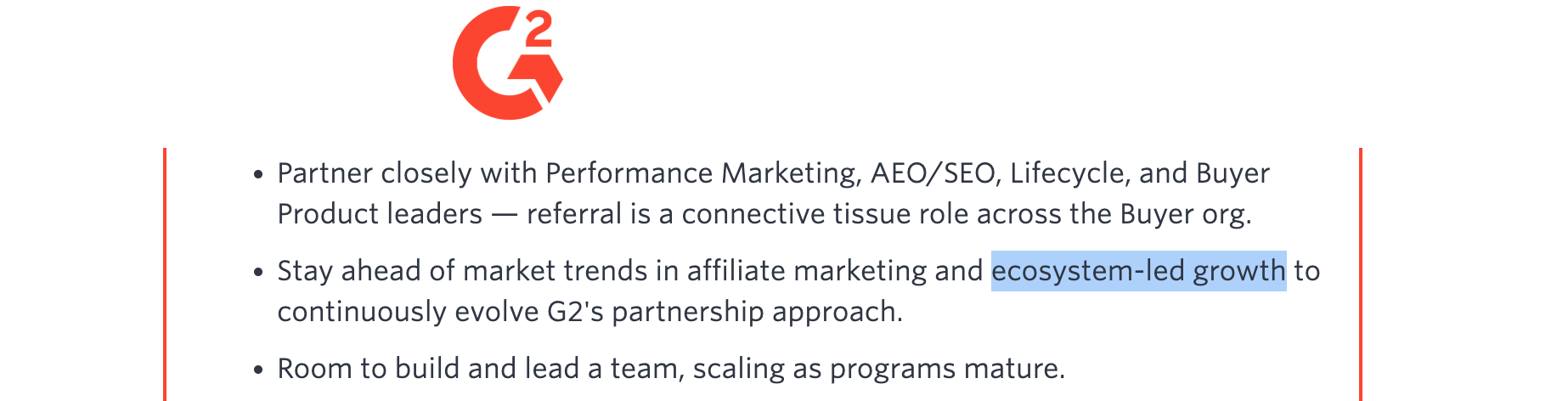
When I was VP of brand and content at Crossbeam I had a Google Alert out for “Ecosystem-Led Growth” — our owned term for using partnerships to drive revenue. One day early in our project, an alert came through. It was a job listing where the candidate needed experience with “Ecosystem-Led Growth”, a term we made up a few months earlier.
It wasn’t direct revenue. It wasn’t a lead. But it was a sign that another business was structuring their organization according to the thought leadership we were publishing. The market was starting to play by our rules.
Now, rather than a Google Alert for clients, we have a Claude agent using its built-in web search, Exa, Podscan, Bright Data and others to find and categorize off-site non-linked mentions of the terms we are popularizing.
(And by the way, six years later the term is still in job posts.)
Publishing cadence
Do you publish when you say you are going to publish at the speed you said you are going to publish? This is a good measurement for two reasons:
- 1Internal morale and credibility: The curse of marketing is all of your work is visible to the entire org. The blessing is that all of your work is visible to the entire org. A general sense of “that team is shipping!” is a win that unlocks buy-in from others. Like, say, that designer you want to make your research report. Or that VP of Sales you’re asking to train her team to use your work in the sales process.
- 2External habits. You are building a new habit for your audience. The least you can do is show up every time you say you are going to. Further, consistency is a moat. Of the 359 companies with a podcast that we track, 48.5% haven’t released an episode in 90 days. 19.5% of companies with a blog that we track have not published in the past 90 days. By virtue of having months of regular content you’re starting to be in the top third of your peers and likely near the top of your category.
Newsletter replies
Tracking opens and clicks is one thing, but having actual humans reply? That’s the good stuff.
You can help your cause here by ensuring your email is from a person and not the brand. Infuse your subject lines and opening paragraphs with a strong voice and point of view. The kind of thing that makes someone reflexively respond with a “Hell yeah! Finally!” or a “I disagree!”
Speaking of…
You get your first hater
When your editorial takes a point of view (it is taking a point of view, right? Right?) someone will disagree with it. In fact, someone should disagree with it. The disagreement alone is a seagull. But the right kind of person disagreeing with you is better. It’s a… larger seagull? A flock of seagulls?
Ideally, your hater is some representative of the status quo, someone with some incentive to keep things the way they are.
Ok, fine, start measuring numbers
Traffic and emails start to be meaningful
Now and only now do you have our permission to use the traffic graphs in your reporting. Go ahead, don’t be shy.
Every content team has the same graph to share. Months of flat lines before the sweat of the team starts to mercifully bend its curve upward. Sites take a while to be crawled and indexed. Habits take a while to change. Even if each post is a relative single, that’s how you play small ball.
In the beginning, you have few people to refer and suggest your content to the people they know. But after nearly two quarters of publishing you should see some signs of life. It rarely looks like a viral breakout hit (though that happens!) and more like:
- *One article gets shared in a community or group text and you see it over perform its peers.
- *Time on page for a deeply reported asset is much higher than the site average
- *People join your email newsletter every day that you don’t recognize
This is when editorial programs get in trouble. They see the early graph rising and want to “scale up” by publishing more or investing money in paid. Ensure your audience is the right one before doing that. Email signups and the source of your anecdotes should be your buyer — or at least influencing your buyer.
An executive boasts
As the proverb goes: Failure is an orphan but success has many owners. When your editorial program hits, you’ll see leaders and executives brag about it internally. Maybe it’s at your standup. Maybe you’re asked to share what you’ve learned.
But the surest sign you are safe on an island is that the person who controls your budget and headcount publicly declares you to be doing a good job internally.5
Keep exploring
If the traffic and email numbers are moving in the right way, the seagulls have taken you to land. Now it’s time to explore how big this island even is. Is your editorial strategy something with lots of growth potential? Some additional long-tail signs you’re on to something:
- *Early posts continue to drive traffic and when you re-promote them to new audiences they see another spike.
- *You start to see themes in audience reactions and your research that you’re brimming with ideas for your editorial calendar.
- *Your internal team is recommending blog post ideas or interview subjects without prompting.
- *Leads and prospects start to self-report that they saw your content as answers to, “How did you hear about us?”
- *Your stats and research are quoted elsewhere.
- *Your team and execs are invited onto podcasts organically.
The biggest sign you’re on to something: your competitors answer you. They write keyword stuffed pages to capture traffic from your terms. They have PPC ads running against your work. They copy your research and reports.
And the surest sign you’ve succeeded: They try to poach your head of content.
Notes
- 1My old boss Ramit Sethi used to call this the “seagull theory.” ↩
- 2This is without really exploring how AI is disintermediating the concept of a “brand” altogether, but that’s a different brief. ↩
- 3Yes, I know that recency is the currency of distribution channels like SEO and AEO. ↩
- 4If someone is not in your target audience, treat criticism with a degree of skepticism. ↩
- 5Successfully reporting your wins and managing up is another brief, but also important! ↩