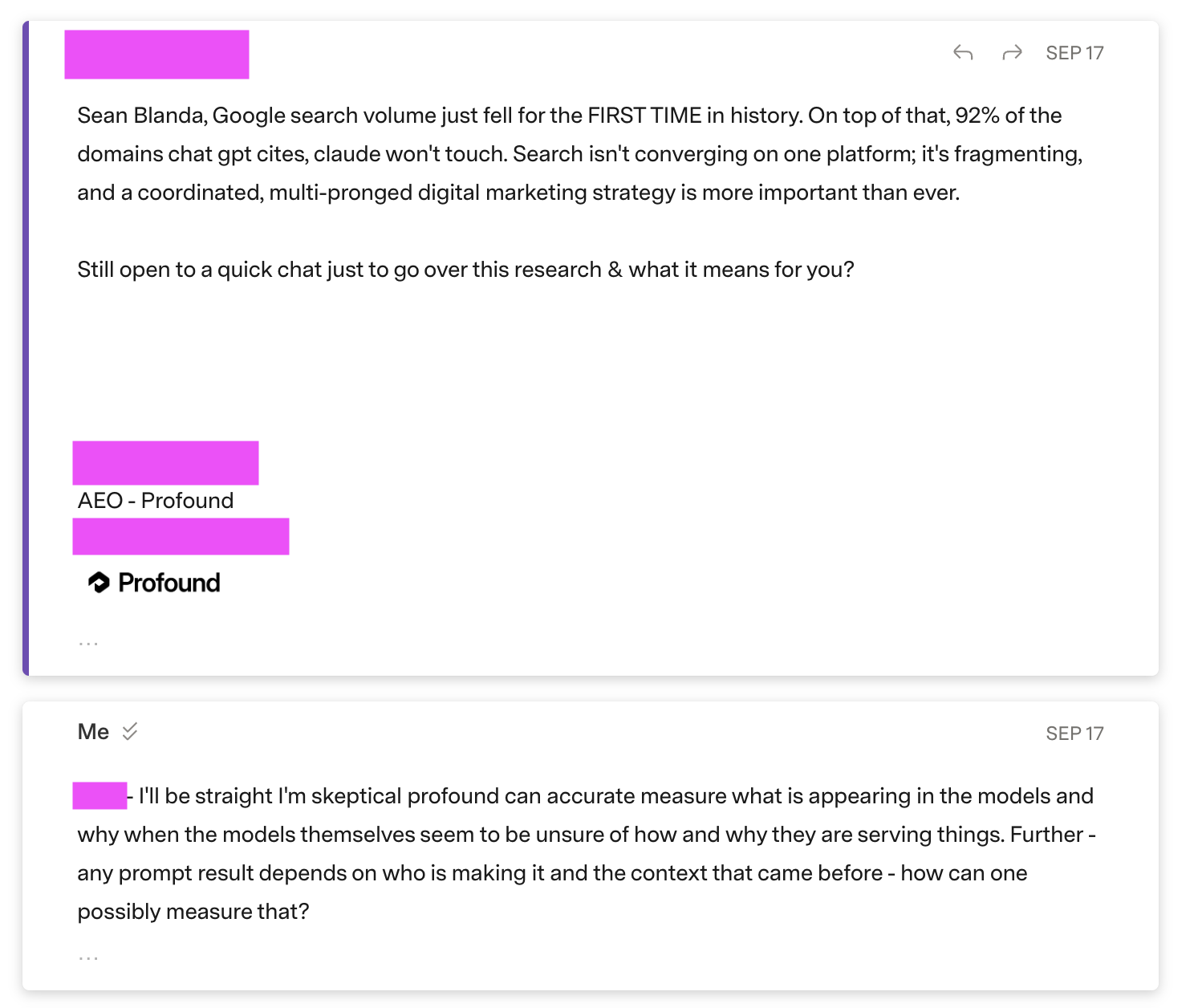
In September 2026, the startup Profound announced it had raised a $180 million Series D at a $1.8 billion valuation. At HubSpot’s cornerstone Unbound (née Inbound) conference, AEO-related sessions tripled from 2025 to 2026, and this year made up about 1 in 6 marketing sessions.1 Of digital leaders, 94% say they plan to “increase their AEO investment.” And in another survey, marketers say AI chatbots are where they most plan to increase investment.
The consensus says that AI chatbots are the future and we need to start moving our attention and resources into AEO (Answer Engine Optimization).2
The logic is understandable. It’s also misguided.
B2B content marketers are repeating a mistake we’ve made for years: seeking a new distribution channel that promises audiences and dollars and then tearing up existing strategies to meet the needs of that platform.
But AEO is different from what came before. It’s the first distribution method that can’t be reliably gamed. Rather, it can’t be gamed sustainably in new ways. AEO does not merit a separate strategy. You don’t need obsessively monitor things like exact position and rankings. And you certainly don’t need to throw your entire strategy overboard to accommodate this new channel.
This is an exciting but confusing inflection point. One that paradoxically returns us to some humble, more human basics. This Anthology Brief is your blueprint for this new era. It covers the fundamental issues with an AEO-first strategy and what you should do instead.
This is what we tell our clients who want to “go all in on AEO.”
Issue #1: Audience (and metric) abstraction
In this AEO transition, we’re witnessing a repeat of the sins of the past. It’s a Groundhog Day-like environment where, despite being burned time and time again, brands and publishers are all too willing to surrender long-term strategies to the latest tech platform — weakening their businesses along the way.
However, this approach is getting less tenable with each era, as our audiences are abstracted away from us in dribs and drabs with AI as the final boss. AEO is “stealing” the SEO traffic and referrals that the industry was depending on for years.
Pew notes that when Google shows an AI summary, people click one of its source links in just 1% of visits, and clicks on regular results nearly halve, from 15% to 8%. Chartbeat found that less than 1% of pageviews on its network come from AI chatbots.3 Semrush: “62% of AI citations don’t lead to brand mentions.”
| Era | New distribution channels | Abstraction level |
|---|---|---|
| Web 1.0c. 1997–2003 | Google, message boards, web rings, email newsletters | Low. Links point to source material. |
| Web 2.0c. 2004–2012 | Twitter, Facebook, social media | Medium. Content hosted on channels owned by Web 2.0 companies. Content distributed reliably to “followers.” |
| Mobilec. 2012–2023 | Video-first channels like TikTok, YouTube, Facebook, Snapchat, Reels. | Medium. Content hosted on platforms, distributed unpredictably by algorithms. |
| AIc. 2023–? | ChatGPT, Claude, Gemini | High. Content summarized and inconsistently linked to source. |
Not only is the audience abstracted, so is the way we measure it. When we don’t have hyper-measurable ways to see how our work appears and if someone clicks through, we’re left with a bit of a directional guess. Some understand this, while a burgeoning industry of people is claiming they can reverse engineer and manipulate the output of the AI models, much like they did with the Web 1.0, Web 2.0, and mobile-era platforms — applying old thinking to the newest thing, down to the keyword measuring tools. In many cases, they are abandoning long-term plays and marketing basics for the gold rush of promised AEO attention.
But those marketing basics and long-term plays are the very things that will lead to successful AEO efforts.
Issue #2: There’s nothing new to do with AEO
Let’s divide the way AI chatbots display information into two simple actions:
- *Find — The AI runs a web search or draws on what it learned in training.
- *Output — The AI outputs what it found to the user.
The issue is that most AEO advice focuses on the “Find” and not the “Output.” And the “Find” best practices are SEO strategies we’ve been doing anyway. The thinking is that AIs conduct “fan-out” searches using a search engine. The goal is to appear in that search.
The issue, however, is in the output. No one is sure why AIs output what they do. Even the labs that make them can’t totally account for why they make certain choices or surface certain information.
“We mostly treat AI models as a black box: something goes in and a response comes out, and it’s not clear why the model gave that particular response instead of another.”
AnthropicSource
“We design the rules of training, but not the specific behaviors that emerge, and the result is a dense web of connections that no human can easily decipher.”
OpenAISource
No one has any way of proving that every time someone types, “Show me the best cargo bikes,” the same companies are listed in the same order. I have a different history and context with the chat session than you do. To say nothing of the fact that the “prompts” are buried in long conversations with long sentences of plain language and not tidy keywords in a one-off search.
SparkToro notes, “There’s a <1 in 100 chance that ChatGPT or Google’s AI, if asked 100X, will give you the same list of brands in any two responses” and that “[while] visibility % across dozens to hundreds of prompts run multiple times is a reasonable metric … any tool that gives a ‘ranking position in AI’ is full of baloney.”
Thus, any defense of the efficacy of an AEO program is, in effect, a defense of gaming the inputs. It’s a defense of the AI chatbot’s ability to conduct a web search and find your work. It’s a defense of SEO. (Non-technical) SEO best practices for years have boiled down to compelling human-written content that contains new information and attracting links and references from other sites and URLs.
So, what exactly is so different from our pre-AEO days?
Why should I be allocating more dollars and resources based on imprecise outputs of AEO measurement tools? Why should I be changing anything about my approach if doing what I was doing before is the best way to have a lottery ticket to appear in an AI chat output?
This, again, is a gift. The SEO era was full of “technical” SEO that encouraged the right schema, derivative content rewrites of top results, and slop cannons pointed at keyword target lists. AEO got rid of the hyper-targeting but kept the value of quality work.
What to do instead
I am not advocating that one ignore AEO, or any distribution channel where their audience is gathering (the audience is there and it’s undeniable). Instead, treat AEO as wholly downstream from more important, impactful — and proven — choices.4
Start with these:
Do not create a separate AEO strategy
You can’t control the AI chat outputs. And the inputs are the old strategy (SEO). Rather, optimize for:
- *Getting humans to share and enjoy your work. You know, like editors and writers and creative people have been doing since forever.
- *Strengthening your SEO practice for unique original work. You know, like the SEO best practices since about 2002 (which is “forever” in internet terms).
- *Avoiding false precision. Monitor dark social5 and referrals from AI chatbots to properly gauge directionality. Don’t overthink this.
Your new job is to be so compelling that your work can appear stripped of a link and context and still entice the user to find you. The best AEO strategy is a competent full brand strategy.
Spend less time fiddling with some AEO monitoring software and more time doing other things. Like…
Conduct original research, but faster
We established that AI chat outputs are not some part of a tidy marketing funnel. They are more like billboards, planting ideas and your brand into the minds of the user — and those users don’t usually immediately click through. Your brand and POV must then be extremely compelling to invite a direct or dark social visit later.
That means having original perspectives and data. Surveys. Interviews. Analysis. Use a journalistic or research process to uncover new information.
This is better for the algorithms too, yes. If you’re producing stuff that is common knowledge, the platforms will quickly summarize that known information and circumvent you.
But it’s better for your audience. They have infinite options. Why choose you? How are you interesting and useful and different?
This is where AI is a boon. In-house marketers can have an agent slice and dice internal data without the need for a data analyst. We can develop basic interactive quizzes and games without a developer. We can create charts and landing pages without a designer.6 As content marketers, we should know our audience better than anyone, and the loop from ideation to execution has never been tighter. As a writer and an editor, I love having AI poke holes in my thinking and spar with me.7
This is exciting! And way more fun than worrying about Claude’s new way of conducting fan-out searches or whatever. It’s also better for the business. We see it in our own client work, and the data backs it up.
“The problem isn’t that content marketing is less effective,” Orbit Media co-founder Andy Crestodina writes. “The problem is that content marketers stopped doing [the] most effective content marketing. This is clear in the data.”
Create repeatable ways to find new information, research and experts, and turn them into things the audience can use. With that in place, an algorithm change means tweaking at the margins rather than overhauling your entire program.
Develop long-term intellectual property
This is sometimes expressed as a preference for “taste” or “craft.” In other corners, it’s taking an “audience-led” approach. In either case, it means making things that build deep, trusting relationships with your human audience. This is a traditional approach, though it looks a tad different in the age of AI.
Your hidden source of arbitrage is no longer platform dynamics: it’s how patient you’re willing to be.
You have a finite budget and timeline to demonstrate you know what you’re doing. If you translate the SEO context of “rankings” over to AEO and chase them, you will be left frustrated. Early research on AEO shows that gains do not last long:8
- *Ahrefs found that Google’s AI summaries change about every two days, and each time one updates, 45.5% of its citations change.
- *AirOps: “Only 30% of brands stay visible from one answer to the next, and just 20% remain present across five consecutive runs.”
- *Profound: “We found that authority in AI search expires rather than accumulates.”
Even if you nail your AEO, you have to feverishly refresh your work. Or, you can play a different game and develop long-lasting intellectual property that can outlast any platform and be repurposed depending on the distribution strategy. You can create seminal content that your audience shares and mentions for months. Or you can feverishly refresh and retool your AEO blog posts. I know where I’d rather spend my time and budget.
One of our criteria at Anthology is vetting possible clients for a long-term mindset. Early wins are possible, but should be treated as a signal toward something greater. You may not ride the spikes of attention that come with chasing a distribution channel. But growing 5% each month is 80% yearly growth. These gains compound.
Own the relationship with your audience
A funny thing has happened to many of our clients as AI has taken hold: we’re seeing a massive rise in bot traffic. This has led to lots of filtering to deliver an imprecise directional count of audiences. But rather than measuring visits, reposts, or comments, measure the humans at the end of the journey. Who comes to your event? Who buys? Who signs up for a trial or demo?
Most AEO programs measure “impressions” or mentions in AI chatbots. That can be helpful to ensure a general positive direction, but the SEO era of exact SERP rankings is dead. It’s a finger in the wind and not GPS.
The best audience growth vectors are ones where a person has to manually share what you’ve written because it’s so entertaining, compelling, or useful. The real-time analytics company Chartbeat conducted a study of 2,500 domains in its network and discovered as much:
“The data points to a shift in how readers are finding and using publisher sites. Direct traffic is taking a larger share, internal recirculation is up and private sharing through texts, DMs and apps like WhatsApp has surged. Meanwhile, publishers’ most loyal readers are generating more pageviews than they did two years ago.”
Bron Maher, A Media OperatorSource
AI makes this easier for the savvy content marketer. I don’t need some data analyst to build dashboards about how my work is performing. I can roll my own measurement, listening software, and list enrichment. I can even surface custom content depending on the actions of individual audience members. Before, I needed an entire team for this and it was often bumped down behind the priorities of other teams (mostly product and sales).
Further, news publishers, whose businesses depend on producing work so original, useful, and compelling that readers will pay for it, are noticing that while Google referrals are down, pageviews are stable. The hedge against decaying SEO is original work.
Stop orienting your teams around platform manipulation
The smart teams are starting to notice that a dollar spent on AEO is better spent on things that are upstream of AEO. And a generation of marketers who thought they were creative is finding out in bracing ways that they were just good at explaining platform dynamics.
While every marketer needs to understand platform dynamics, the creativity and the human connection are now the “growth marketing hack” that will survive. Every blog post you remember or conference you enjoyed is most likely the result of a single, stubborn son of a bitch who was the arbiter of the brand’s POV, stayed in tune with the audience, and overruled committees.
Your job is to foster a creative practice that can exist within the confines of your company. Too often brand and content teams are seen as extensions of the business goals of the company. They aren’t beholden to the business, they precede business. They set the conditions for new people to deeply understand and trust the business before they ever think of a transaction.
Before, but better
Contrary to some doomsayers, AEO and AI are not the end of original, human thinking. The "doom" lies in its capacity to distract. AEO is not a stand-alone strategy. It's a downstream representation of your entire brand and content marketing program. Treat it as such.
If you want to enter this new era in a stronger position than you were before, you know where to find John and me.
Notes
- 1Counted from the conference’s own session catalog, pulled September 28, 2026. A session counts if its title or description contains “AEO,” “GEO,” “AI search,” or “answer engine”; repeats are counted once. 2025: 4 of 253 sessions. 2026: 12 of 248, including 11 of 67 in the marketing track. ↩
- 2Sometimes called “Generative Engine Optimization (GEO)” or “AI Search” ↩
- 3Interestingly, the same study found that internal traffic was up. Which means the people that do arrive at your site may be more likely to poke around. ↩
- 4AEO is like a billboard: Can you accurately measure if someone has seen a billboard that resulted in a purchase? No. So goes AEO. It’s an immeasurable brand play. Worth doing, but do not apply false precision to it. ↩
- 5Dark social: sharing through private channels — texts, DMs, email, group chats — that analytics tools usually record as direct traffic. ↩
- 6It’s another essay, but design is absolutely needed for the holistic content marketing program. What we’ve seen is designers move to building a design system for non-designers to operate under, saving time for high-leverage projects. ↩
- 7That’s how AI was used in this essay. After sending to some friends, I had it pressure test as much of this as possible and find writing that supported and refuted my thinking. ↩
- 8I’ll acknowledge the conflict of interest here: these vendors want to sell you monitoring software. It’s the best quantitative data I could find, though I welcome it if anyone reading this has more! ↩