
In today’s ever-evolving digital landscape, we are truly living in a remarkable golden age of content. It’s not just that it’s easier to write pieces, but also the finished product is more enjoyable to read.
Wait, sorry, you’re absolutely right – that was AI slop!
Take 2: we’re hiring a human writer.
— Crosby, job listing for a Writer
And so opens a recent job ad from Crosby, the AI-native law firm that’s on a roll at the moment.
The company is deep into AI, so better positioned than most to make the call that LLMs produce “a lot of average writing”. But Crosby sells to general counsels at Fortune 500 companies, founders of high-growth AI startups, CROs at big finance firms. Average writing isn’t going to seal any deals for them.
Crosby is not the only fast-growing startup that’s come to this realization. Deepgram is hiring a Head of Editorial Content. Perplexity is hiring a Senior Editor to “own editorial quality end to end”. Ashby is hiring a content lead for its Talent Trends series of data-driven reports. Syndication tool Stacker recently launched a weekly newsletter devoted to job openings in what it’s calling “brand journalism”.
This subjective conclusion that we’re seeing a renaissance in editorial hiring in the broader software industry led us to do some research of our own. Our first pass found 854 open roles related to “owned-media” which we defined as content/editorial, brand, communications, social/community, video/audio, and developer relations i.e. the functions related to helping a company tell its own story. There were a total of 426 companies hiring i.e. the companies investing in storytelling were usually doubling down with more than one role related to it, while the seniority of the function was also telling – 152 were director and above. Zeroing in on specific editorial roles, we found 301 roles with editorial in the title.
| Function | Open roles | Mention “quality” |
|---|---|---|
| Content / editorial | 288 | 159 (55%) |
| Communications | 175 | 72 (41%) |
| Social / community | 167 | 56 (34%) |
| Brand | 107 | 43 (40%) |
| Video / audio | 59 | 32 (54%) |
| Developer relations | 58 | 22 (38%) |
| Total | 854 | 384 (45%) |
This resurgence of editorial roles is most pronounced at AI-native companies, the very ones you’d expect to be embracing AI-driven content production. But instead they are looking for journalists, story-tellers and creatives who can create high quality content that will ultimately help to sell their enterprise offerings.
To be honest, that’s not just a huge relief but also a significant endorsement for the way we approach things at Anthology. I’ve been working in content marketing for well over a decade, and I’ve always positioned what I do as quality editorial. Sean does the same. Our editorial approach is all over the Anthology website. We pitch it to potential clients. It’s what we all agree we’ll be doing when they sign on.
The problem is, I’ve always had a sneaking suspicion that we’re not all on the same page. We’re not all aligned on what “quality editorial” really means, and this recent rash of hiring for editors and journalists to work on content has just confirmed it.
My editorial is probably not your editorial
Even though the term “editorial” is widely used in marketing circles, in my experience different stakeholders have wildly different interpretations of what it means. For your typical CMO, who is at a remove from the day to day or content production, quality editorial might mean “polish” and “attention to detail”. For founders, it probably means higher quality than a content farm but slower and more expensive. (“I know we should do this but we have more pressing and immediate problems,” is not an untypical founder response to investments in quality content). Growth leads definitely hear “stuff that will never bother my dashboard,” even if they know in their heart that quality content would elevate their campaigns.
So what does Anthology mean when we talk about editorial content? It’s content that is unique to your company and the problems facing your customers. It demonstrates your specific domain knowledge while delivering something of value to the reader. It’s created not to game an algorithm, but to impress a human. It’s put together using journalistic rigor and quality standards. And probably most important of all, it’s additive i.e. it’s not just a summary or roundup of prior art, but offers something new by way of original research, interviews or at the very least reflection on the part of the author. Think Intercom’s series of books, Ramp’s monthly spending reports or Clarify’s recent guide to founder-led sales – hugely impactful publications I’ve been involved with over the last decade.
With this in mind, I decided to review some of the more recent listings for editors and writers that have been posted. What is the vision for content? Are they looking for the right kind of person? What can we learn about the company’s understanding of how editorial can sell software?
Admittedly, trying to reverse engineer content strategies from job listings is not the most scientific approach. There’s lots of context I don’t have on each of these companies and their marketing teams. Despite that, we can learn a lot about how the company thinks about the function by looking at the way they describe the role and the kind of person who can best fulfil it. I also think the exercise is helpful for those of you who want to develop an editorial strategy that will stand out from the sea of AI-slop and decidedly average content.
Perplexity
Senior Editor · View the listing
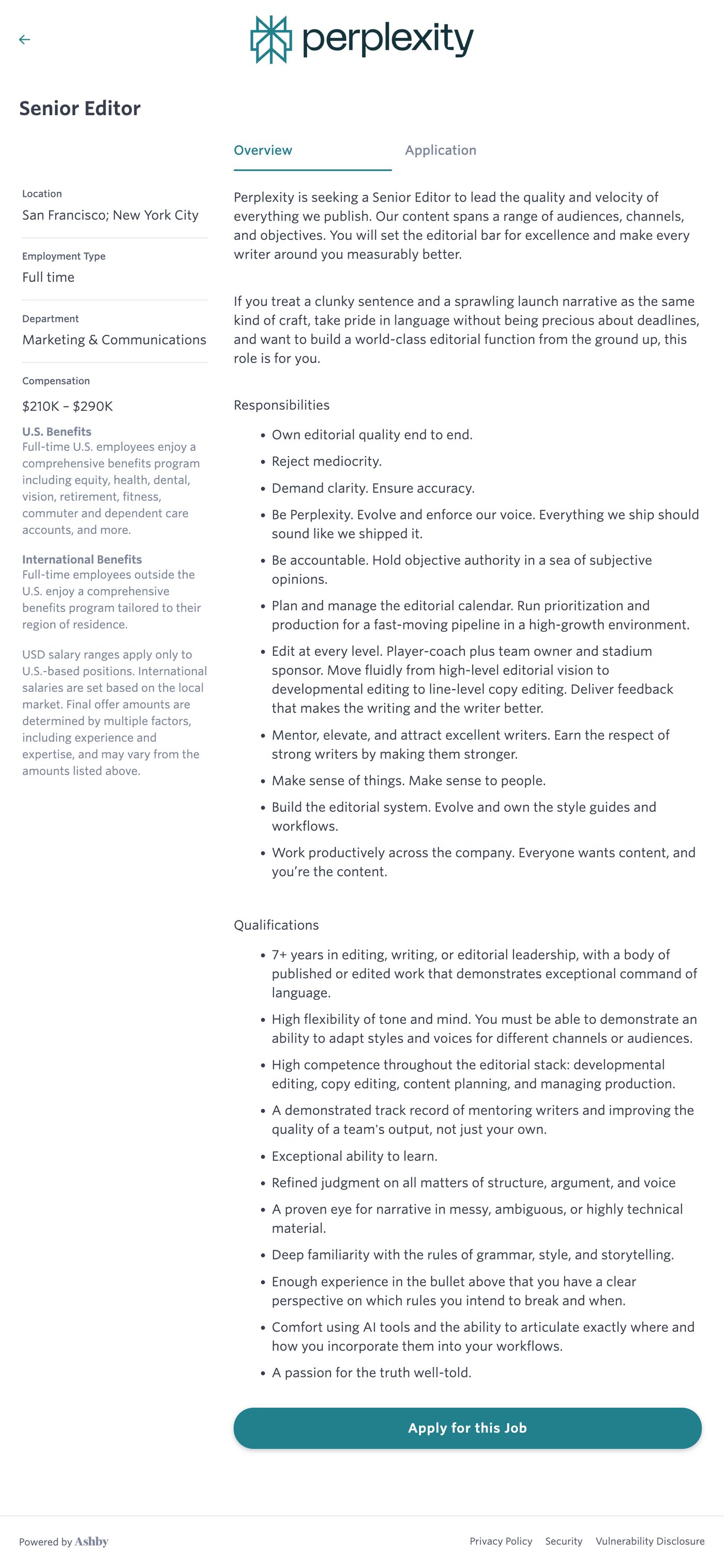
It’s notable that Perplexity is making a significant bet on editorial — it guides a salary of $210K-$290K for its Senior Editor role. Which might explain why its job ad feels a bit like a description of a unicorn candidate. The successful candidate will increase the “quality and velocity” of everything Perplexity publishes while also editing at every level from high-level vision to line editing. They will also “hold objective authority in a sea of subjective opinions”, and handle “prioritization and production for a fast-moving pipeline in a high-growth environment”, all while mentoring, elevating, and attracting excellent writers. Editors who can zoom in and out between in the weeds editing and strategic vision are thin on the ground, so it’s likely to be a long search.
From this JD, it sounds like Perplexity wants more of everything at speed – which is never a good environment to create quality content in. On the plus side, Perplexity sees this person building a “world-class editorial function from the ground up” so at least they have an awareness that to do this properly you need to invest in talent not just tools. That said, there’s lots to like about how they’re thinking about the role and its scope, such as evolving and enforcing Perplexity’s voice, collaborating right across the organization, and getting the imprimatur to build out an editorial system.
- Comment
- Kudos for the vision, but one person can’t do all of this
- Quality metric
- Output without sacrificing quality
Ashby
Content Lead, Talent Trends
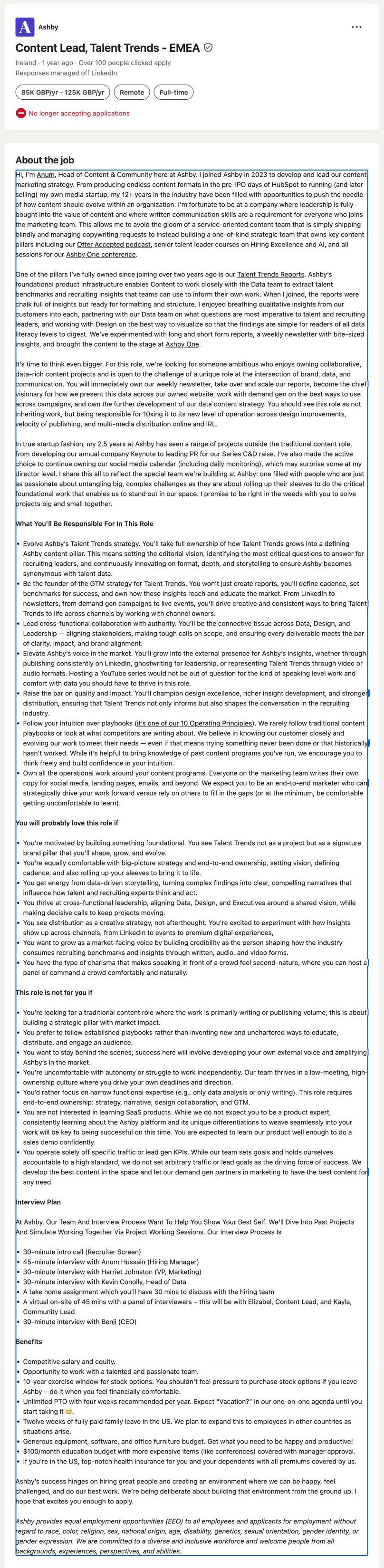
Ashby already has an experienced Head of Content & Community (Hi, Anum 👋) and is looking to fill a role on a specific publication, Talent Trends, rather than a more general “fix/create all the content things”.
The strategy already exists and is clearly outlined in the job description. You’ll partner with the data team to get hiring benchmarks and insights from the platform, interview customers to add some qualitative color, and partner with the internal design team to present the learnings in the best possible way. Editorial content is set up to succeed when it develops these partnerships across the organization.
Having experimented with long- and short-form reports, a weekly newsletter, and even presenting the insights at their own in-person events, Ashby is now doubling down on the Talent Trends content pillar by hiring a lead to own and develop it. We also love that Ashby explicitly states that this is not for someone who wants to be “primarily writing or publishing volume; this is about building a strategic pillar with market impact”. Content that achieves a strategic goal is far more important than simply upping the quantity of what you publish.
- Comment
- Clear strategy ready to be handed over to a candidate who will know exactly how success is going to be measured
- Quality metric
- Building an impactful publication for recruiters
Crosby
Writer · View the listing
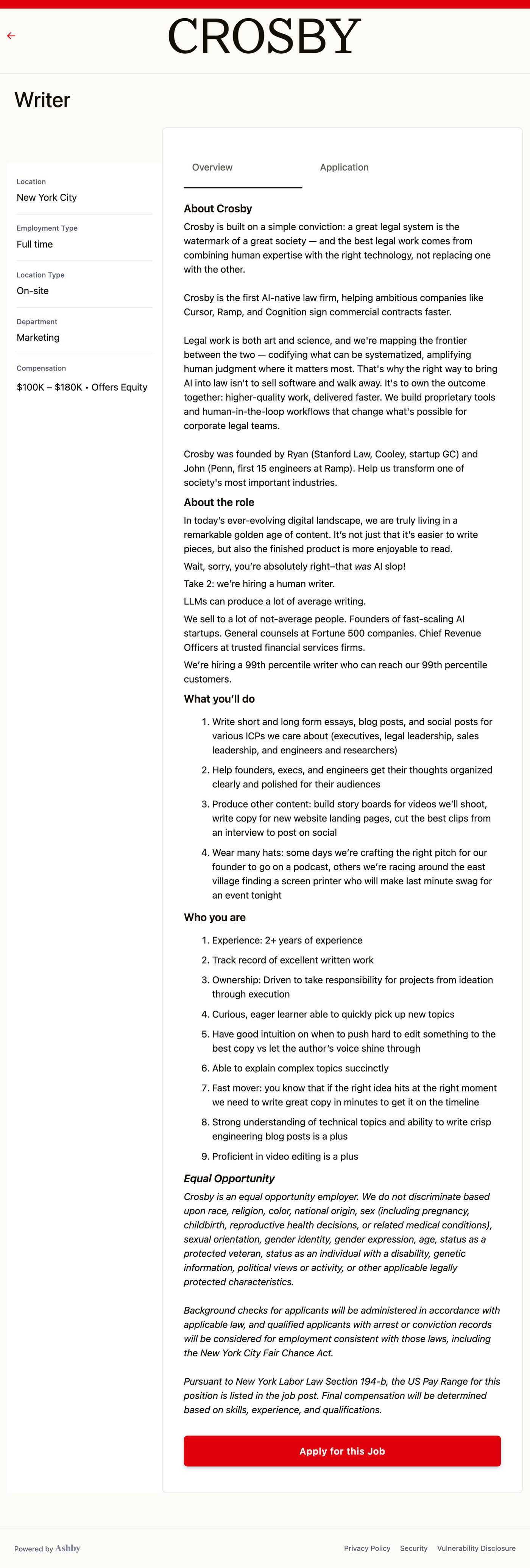
At a startup, the challenge when writing the JD for a specialist role like writer or editor, is that generally it’s being written by someone who has never done the role before. Which is why there can be unrealistic expectations around the scope of the role.
Fundamentally, Crosby wants a human writer that can create content that will attract the attention of its exacting enterprise customers. But the listing also suggests it hasn’t really decided if its writer will focus on quality or quantity, or even which channels are likely to be most important. Not only will they write “short and long form essays, blog posts, and social posts” for a variety of ICPs from legal leadership to engineers, they will be responsible for a mixed bag of “other content” including video storyboards, website copy, and cutting social clips.
You’ll definitely find writers who can turn their hand to all those formats. But people who can do them all really well, while doing all the foundational things needed at a startup like capturing the brand voice, are pretty rare. Not surprisingly the candidate will need to be a “Curious, eager learner able to quickly pick up new topics”.
The description that a typical day might include racing around the East Village looking for a last minute screen printer to create swag for an event that day also muddies the water. Folks that will roll their sleeves and do what needs to be done are essential at startups, but this detail is unlikely to attract senior candidates.
- Comment
- The role is focused on writing, which will allow the candidate to develop the Crosby voice, but asking the candidate to wear too many hats will dilute their impact.
- Quality metric
- Executing a very broad range of writing
Deepgram
Head of Editorial Content
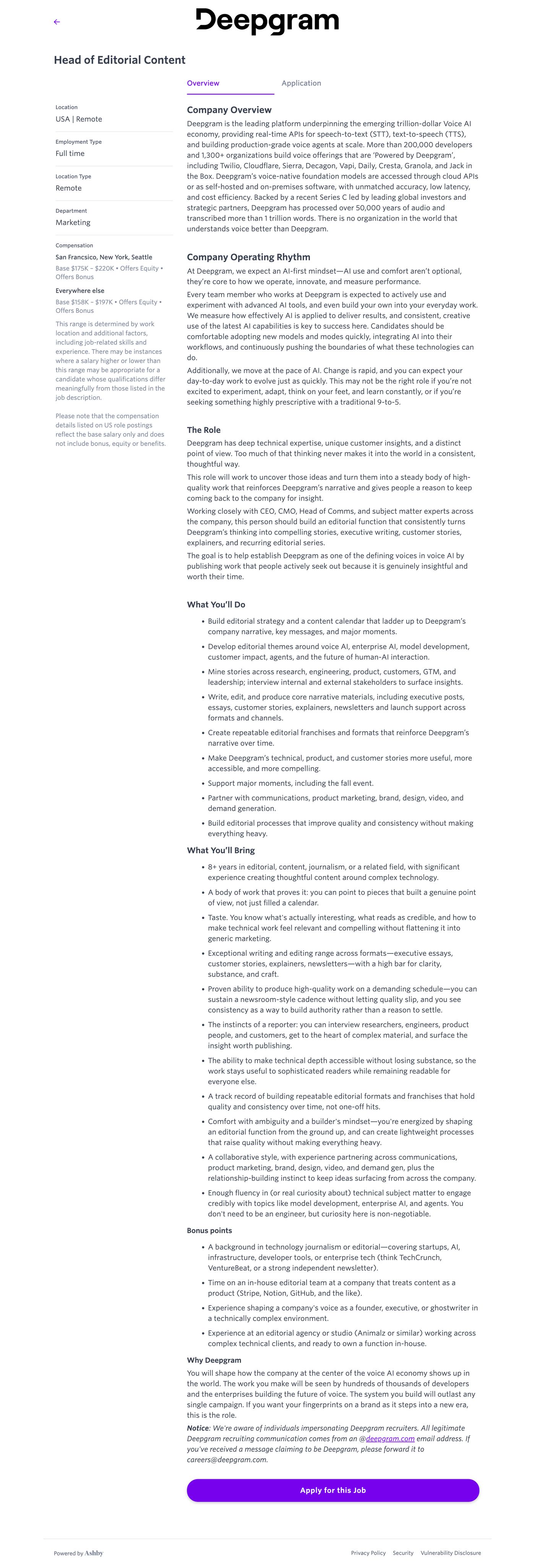
Deepgram’s listing displays a deep understanding of editorial content and what it can deliver for a business. The listing opens with the problem they are trying to address, which is that too much of its original thinking stays inside the company and is not shared with the world. The new editorial leader will uncover those ideas and turn them into high-quality work which “reinforces Deepgram’s narrative and gives people a reason to keep coming back to the company for insight”.
This JD pretty much reads like a list of things I would do if asked by a startup to establish an editorial function. First create a strategy that ladders up to Deepgram’s narrative, messaging and upcoming events. Then develop editorial themes around the topics that are relevant to the company e.g. voice AI, enterprise AI, agents, and model development. Finally mine for stories across the other functions of the company, from engineering to customer success, while interviewing both internal and external sources for additional insights.
Bonus points: the successful candidate will work closely with the CEO, CMO, Head of Comms, and subject matter experts across the company. The quickest way to make sure an editorial strategy fails in its infancy is not having the support of senior leadership. The minute you publish something that attracts attention but ruffles some feathers, the program will get canned.
- Comment
- Clear understanding of how editorial content can help the company and what they need to do to support that.
- Quality metric
- Crafting Deepgram’s insights to share with the world
So what does this exercise teach us? For anyone who believes in the power of quality, original content to move the needle, it’s an incredibly positive development that the leading startups of this generation are investing in it. If the businesses at the forefront of AI applications don’t think they can replace editors and writers with some smart agents and skills, should any of the rest of us be heading in the same direction.
It’s also notable that the better job descriptions are not just looking for polished prose or the ubiquitous ability to tell a story (although both are important). Instead they are looking for someone who can take what’s unique about the business – years of proprietary data, hard-won opinions on their industry - and turn it into something worth reading. That’s what differentiates an investment in quality editorial, from simply scaling up the production of average content.
How you can get started
Embarking on an editorial path takes thought and time – doing this poorly is potentially more damaging for your brand and business than doing nothing at all. The first step is getting all your key stakeholders aligned and comfortable with potentially being uncomfortable as you execute the strategy. Do that work up front and you’ll not only do your strategy justice but your editorial team will also be set up for success.
Get started by honestly answering the following questions:
- 1Who exactly are you writing for and will your content make them more likely to buy your product?
- 2What do you know, or what can you see in your data, that people outside your startup don’t?
- 3Who internally has the expertise to talk about this and who owns getting it out of them?
- 4What positions are you willing to take that others in your market will disagree with?
- 5Will your founder put their own name to your content and give it a year to deliver?
At Anthology, we have lots of experience answering those questions and forming the answers into an actionable strategy. Get in touch for a free initial discussion.